
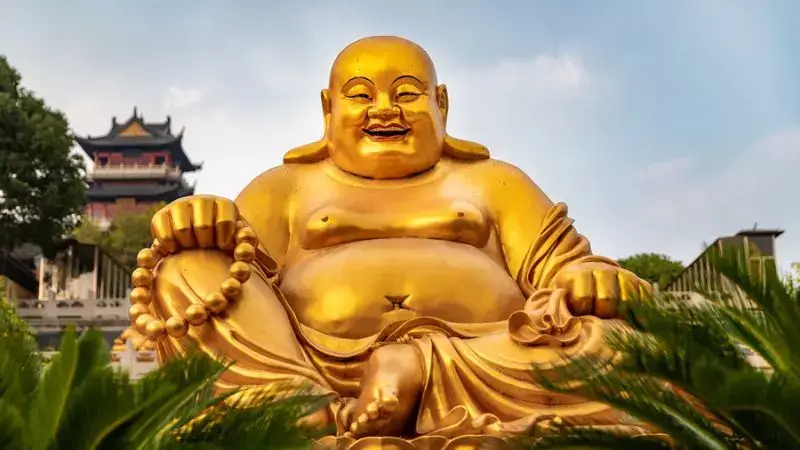
With a beaming smile, Maitreya Bodhisattva always radiates a sense of joy and ease. But have you ever wondered: Is Maitreya Bodhisattva the same as the Maitreya Buddha people commonly refer to? What spiritual symbolism does Maitreya represent? Why is his statue different from other Buddhas and Bodhisattvas, always wearing a wide, cheerful grin?
This article will take you through the story and origins of Maitreya Bodhisattva, and answer common questions about him—helping you better understand his spirit of compassion, joy, and tolerance.
What Is the Origin of Maitreya Buddha? Discover the Story of Maitreya Bodhisattva
“Maitreya” is a transliteration of the Sanskrit word Maitreya, which means “Compassionate One.” He is also known as Ajita, meaning “Unconquerable.” Maitreya Bodhisattva is one of the Eight Great Bodhisattvas in Buddhism. In Mahāyāna teachings, he is classified as a Bodhisattva of Equal Enlightenment (equivalent to Buddhahood), also called a “One-Life Bodhisattva” (Eka-jāti-pratibaddha)—meaning he will attain Buddhahood in his next life.
Because Sakyamuni Buddha prophesied that Maitreya would descend to the human world and attain enlightenment after him, taking on the mission of saving sentient beings, Maitreya Bodhisattva is also known as Maitreya Buddha, or the
Future Buddha.
Here’s a look into his past-life story and the origins of his deeds as the future Buddha:
The Previous Life of Maitreya Bodhisattva
According to Buddhist scriptures, Maitreya was born into a Brahmin family in Southern India. Gifted with wisdom from a young age, he later became a disciple of Sakyamuni Buddha. Twelve years after the Buddha entered nirvana, Maitreya ascended to the Tuṣita Heaven, where he currently resides and teaches as a Bodhisattva, presiding over the Inner Court of Tuṣita.
The origin of Maitreya is recorded in “The Sutra on the Cause and Condition of the Compassionate Mind of the All-Knowing Bright Immortal for Not Eating Meat”. In a past life, a Brahmin youth named “All-Knowing Bright Light” became a disciple of a past Buddha also named Maitreya. After diligently practicing, he vowed that when he attained Buddhahood, his Buddha-name would also be Maitreya.
Later, he retreated to the mountains for ascetic practice, living on alms. One day, due to a flood, he went seven days without food and neared death. At that moment, a mother rabbit and her child, in order to uphold the Dharma, threw themselves into a fire and offered their roasted flesh to sustain the practitioner. Deeply moved, he vowed:
“May I, in all future lives, never give rise to the thought of killing, never eat the flesh of sentient beings, always abide in the Compassionate Samadhi until I attain Buddhahood and establish the precept of abstaining from meat.”
That ascetic was the future Maitreya Bodhisattva. Because of this boundless compassion, he is known as “The Compassionate One.”
The Origin of Maitreya Buddha’s Deeds
According to the Surangama Sutra, Maitreya said that during the age of the Buddha Dipankara, he too renounced the worldly life but retained strong attachments to reputation and social status.
During the era of Sakyamuni Buddha, Maitreya still carried these tendencies. Although criticized by other disciples, Sakyamuni affirmed Maitreya as the future Buddha, who will descend to the human realm 5.67 billion years from now to attain enlightenment and guide sentient beings. This was not favoritism, but acknowledgment of Maitreya’s countless lifetimes cultivating compassion. He constantly abides in the Compassionate Samadhi, radiating great light to eliminate karmic obstacles and bring peace to all beings.
According to scriptures, when Maitreya’s time in Tuṣita Heaven ends (after 4,000 heavenly years), he will descend to the human world. At the age of eight, he will renounce, cultivate, and attain enlightenment under the Dragon Flower Tree (Nāgapuṣpa), becoming Maitreya Buddha. There, he will teach the Dharma through three great assemblies—known as the Dragon Flower Three Assemblies—and save all beings with karmic connection.
What Does Maitreya Buddha Oversee? Why Is Maitreya the Future Buddha? 2 Common Questions Explained
After learning about Maitreya’s origin and story, here are answers to two frequently asked questions to help you understand his title and appearance:
Why Is Maitreya Called the Future Buddha?
In Buddhism, the “Three Buddhas of Time” represent the Buddhas of the past, present, and future: Dipankara Buddha, Sakyamuni Buddha, and Maitreya Buddha.
Maitreya currently resides in the Inner Court of Tuṣita Heaven, where he teaches celestial beings. According to Sakyamuni’s prophecy, 5.67 billion years from now, when Earth has become a land of peace and harmony, Maitreya will descend to continue the Buddha’s mission. He will attain enlightenment under the Dragon Flower Tree and then hold three great Dharma assemblies to teach sentient beings of all capacities—this is known as the Dragon Flower Three Assemblies. Hence, Maitreya is honored as the Future Buddha.
Why Is Maitreya Always Smiling?
In India, Maitreya’s images depict him wearing a jeweled crown, celestial garments, and adorned with ornaments—exuding dignity and majesty.
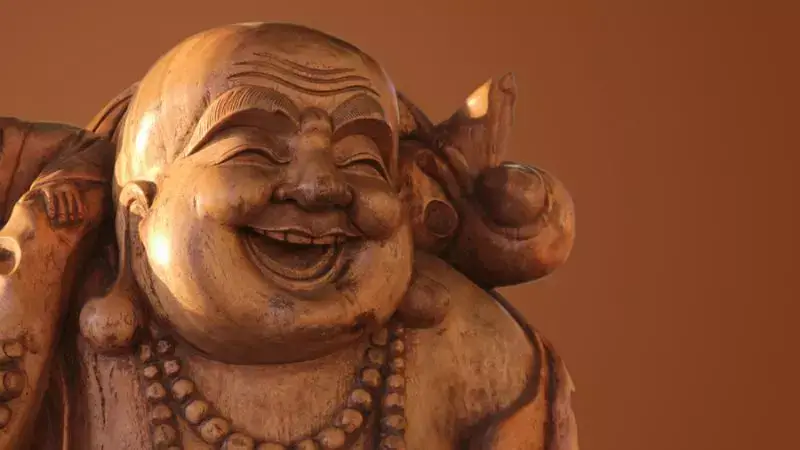
However, as Buddhism spread to China, Maitreya began to be depicted as a bald, big-eared, bare-bellied figure with a cheerful smile. This transformation primarily originated from Qici, the “Cloth Bag Monk”, during the Later Liang period of the Five Dynasties.
Legend says Qici was short and plump, always smiling, and carried a large cloth bag, wandering and begging for alms. No matter how much was put in, the bag never filled. This symbolizes a heart of great tolerance—able to contain everything. With no attachments, one can live joyfully and freely.
He once said:
“I have a cloth bag, empty yet unhindered. Opened, it fills the ten directions; at all times, I observe freedom.”
According to the “Record of the Transmission of the Lamp”, before passing into Nirvana, Qici left a verse:
“Maitreya, the true Maitreya, manifests in countless forms. Always teaching in the world, but few recognize him.”
It was only then that people realized the miraculous Cloth Bag Monk was an incarnation of Maitreya Bodhisattva. Thus, Maitreya is often portrayed as approachable, compassionate, and joyful—radiating positive energy and deeply loved by all.
Bodhi Meditation Helps You Understand the Compassion and Wisdom of Maitreya Bodhisattva
Throughout many lifetimes, Maitreya Bodhisattva has diligently cultivated compassion. In the samadhi of loving-kindness, he radiates light to all sentient beings, helping them attain peace and freedom. This aligns perfectly with Bodhi Meditation’s core mission.
Grandmaster JinBodhi states that the Bodhi path is the path of compassion. His teaching, the Meditation of Greater Illumination, shares a profound similarity with Maitreya’s “Compassionate Samadhi.”
If you wish to understand more about Buddhist wisdom and the spirit of compassion, you are welcome to join online classes personally led by Grandmaster JinBodhi, or visit Bodhi Meditation Centers to experience energy healings and learn the Meditation of Greater Illumination. It will help you improve your health, develop wisdom, clear negative karma, accumulate blessings, and walk toward a beautiful life.
Learn About Other Buddhas and Bodhisattvas:
https://www.jinbodhi.org/en/category/encyclopedia/buddhas-bodhisattvas