

Have you ever been puzzled by the phrase “The Five Aggregates Are Empty” while reading the Heart Sutra? This article explains the meaning behind this phrase by helping you understand the five aggregates—form, feeling, thought, action, and awareness—and their distinctions. We’ll also share practical ways to realize “emptiness of the five aggregates,” helping you gradually elevate your spiritual state, free yourself from worldly afflictions and suffering, and live a healthy, joyful life as you step into a new phase of spiritual awakening.
What Does “The Five Aggregates Are Empty” Mean? The State of “Non-Self”
The phrase “The Five Aggregates Are Empty” comes from a line in the Heart Sutra:
“Bodhisattva of Perceiving Ease, when deeply practicing prajna-paramita, perceives that all five aggregates are empty, thereby overcoming all suffering and distress.”
To understand this, we first need to break down the concepts of “five aggregates” and “emptiness.”
The “five aggregates” (五蘊) refer to the five essential components that constitute the universe, the world, and even human life: form, feeling, thought, action, and awareness. These include both internal and external phenomena and are seen in Buddhism as what makes up the “self.” Sentient beings perceive the five aggregates through the six faculties—eye, ear, nose, tongue, body, and mind (consciousness). These faculties interact with the external world, giving rise to cognition and emotions, and with them, suffering and bondage.
“Emptiness” (空) literally means “nothingness” or “non-existence,” but in Mahayana Buddhism, it has a deeper meaning beyond mere existence or non-existence. It points to a state that is inexpressible, inconceivable, and unattainable. Thus, “the five aggregates are empty” does not mean they do not exist, but rather that they have no inherent, independent nature—they are impermanent and ever-changing. One should not cling to them. When a person truly realizes this, they transcend attachment to “self” and “mine,” entering the state of non-self and inner freedom.
Attaining a true realization of “the five aggregates are empty” is not easy—it is considered a very high state of realization. However, we should not give up trying. Instead, treat it as a lifelong path of spiritual cultivation. We are constantly learning to let go of attachments—both material and emotional. As the mind becomes clearer and calmer, the influence of the aggregates weakens. With that, suffering and afflictions diminish, and peace and ease arise. Gradually, we move closer to an ideal life filled with joy and serenity.
Explaining the Five Aggregates in Buddhism
After the above overview, you may have a general idea of what “the five aggregates are empty” means. But what exactly are the five aggregates—form, feeling, thought, action, and awareness? Let’s explore them one by one:
1. Form Aggregate (色蘊)
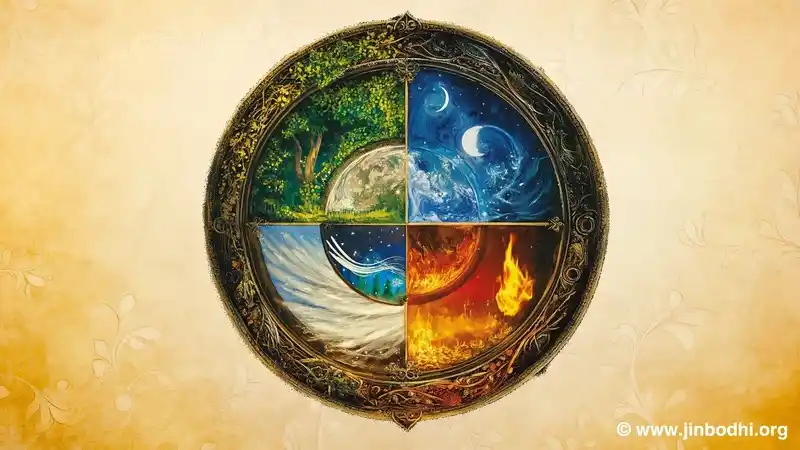
Form encompasses all tangible, visible, and audible matter in the external world and in the body—like sunlight, air, water, food, clothing, shelter, and transportation, as well as our skin, bones, muscles, and blood. In Buddhism, the body is said to be composed of the “four elements”: earth, water, fire, and wind, which interact to form all physical matter. Here’s what each represents:
- Earth: Solid matter—skin, hair, nails, bones, organs, muscles, nerves, etc.
- Water: Liquid—blood, sweat, tears, saliva, urine, etc.
- Fire: Heat and energy—body temperature, digestion, and metabolism.
- Wind: Gas and movement—breathing, ventilation, circulation of internal energy.
2. Feeling Aggregate (受蘊)
Feeling refers to all physical and emotional sensations—those arising from sight, sound, smell, taste, touch, and the internal emotional responses that follow.
Examples include:
Painful: anxiety, sadness, fear
Pleasant: joy, delight, happiness
Neutral: boredom, indifference, emotional numbness
Feelings vary in intensity and depth and they fluctuate with the external environment and mental state. They are impermanent and unstable—just like life. While we cannot control the emergence of feelings, we can learn not to be controlled by them.
3. Thought Aggregate (想蘊)
Perception refers to our thinking and judgment. Like feelings, perception changes over time and with personal growth. Rather than labeling it good or bad, we should focus on how perception shapes our decisions and influences the future. Thus, it’s important to think comprehensively and long-term, instead of reacting based on fleeting emotions or shortsightedness. That is the path to clarity and wisdom.
4. Action Aggregate (行蘊)
This includes all bodily and mental activities—conscious or unconscious—that arise from thoughts. It represents the stream of mental activity that drives behavior and shapes life direction.
It encompasses actions, speech, and intentions. Through it, we manifest our values and pursue our goals.
5. Awareness Aggregate (識蘊)
This refers to awareness and cognition, and includes thinking, memories, and knowledge. It allows us to distinguish colors, taste food, and sense temperature—this is the function of the mind.
It’s considered the foundation of perception:
Awareness (識) gives rise to perception (想)
Perception then leads to action (行)
Example:
A person decides to build a house—this initial intent is awareness (識蘊).
They then imagine what the house should look like—this is thought (想蘊).
They draw blueprints and begin construction—this is action (行蘊).
The finished house, with its physical structure and materials—this is form (色蘊).
Feeling joy and satisfaction after seeing the house is feeling (受蘊).
“The Five Aggregates Are Empty” Begins with Practice | Bodhi Meditation’s Retreats Welcome You
The essence of “the five aggregates are empty” is about freedom from suffering and the attainment of peace. While it may seem difficult for ordinary people to attain, Bodhi Meditation provides a practical path toward this realization.
Our global meditation centers provide beginner-friendly health and happiness retreat and chanting retreat, helping people connect with Buddhist teachings from the ground up. Learn to cultivate gratitude and respect, replenish life energy, and transform your destiny. We also offer flexible online courses so you can learn at your own pace.
Follow Grandmaster JinBodhi on YouTube and Facebook for teachings, practice tips, and event updates that support your journey toward realizing “the five aggregates are empty” and attaining a life of lasting happiness.
Further Reading:
The Meaning of Offering: Practicing Generosity in Daily Life to Find Inner Peace