
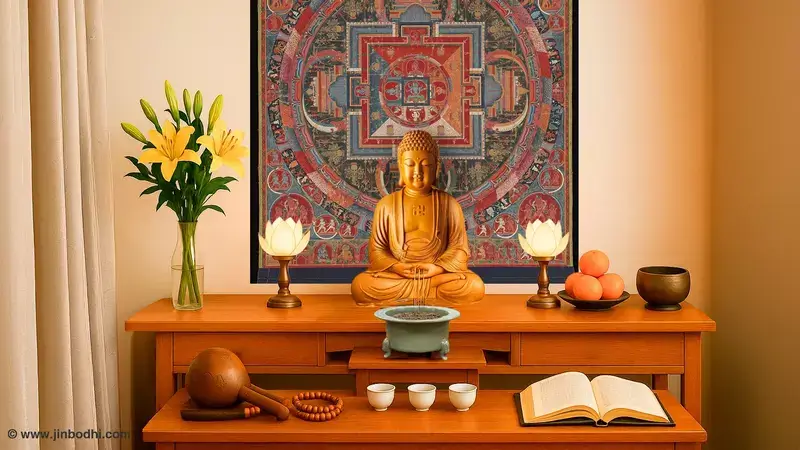
Thinking about setting up a Buddhist altar at home, but unsure of the Feng Shui principles to follow? This article introduces the four main benefits of a home altar, offers guidance on choosing its placement, and outlines the taboos and details of altar setup—helping you grasp the key points before establishing your sacred space. Finally, we’ll also share great resources for learning Feng Shui and meditation, empowering you to change your fortune, deepen your spiritual practice, and build a fulfilling life.
Can You Set Up a Buddhist Altar at Home? 4 Major Benefits of a Home Altar
When people think of meditation, the first image that comes to mind is often worshiping at a temple. However, if you have the space, you can also set up an altar at home, making spiritual practice more accessible in daily life. Here are four key benefits of a home Buddhist altar:
- Convenient for Meditation Practice
Having a Buddhist altar at home allows you to worship, recite Buddha’s name, or read sutras at any time—seamlessly integrating practice into daily life and nurturing wisdom.
- Stay True to Your Spiritual Path
A home altar helps maintain a consistent practice routine and serves as a reminder to stay true to your original intent and continuously strive for improvement.
- Stabilize the Mind
With the sacred images of the Buddhas and Bodhisattvas nearby, the altar creates a peaceful energy that soothes and stabilizes the mind.
- Encourage Dharma Sharing
When friends and family visit, the altar becomes a place for Buddhist exchange—welcoming fellow practitioners and helping newcomers learn about the Bodhisattvas.
Difficult to Meet All Feng Shui Requirements? Follow These 4 Principles to Find a Suitable Spot
Setting up a Buddhist altar involves careful attention to Feng Shui. In addition to the home layout, direction, and surrounding environment, one should also consider the zodiac signs of family members. However, as times have changed and many now live in high-rise apartments with limited space, it may not be possible to fully meet traditional Feng Shui standards. Failing to set up an altar because of these limitations may go against the original, sincere intent to enshrine and make offerings to the Buddhas.
To achieve the best outcome, follow these four guiding principles:
- Good Lighting
Choose a spot with ample natural light, creating a bright and refreshing space.
- Clear Pathways
Choose an open, unobstructed space and avoid cluttered or cramped areas.
- Air Circulation
Ensure fresh and flowing air to maintain a harmonious and clean energy field.
- Quiet and Tidy Environment
Set up in a quiet and orderly place to avoid noise or distractions interfering with your practice.
What Are the Taboos of Altar Placement? Common Feng Shui Pitfalls to Avoid
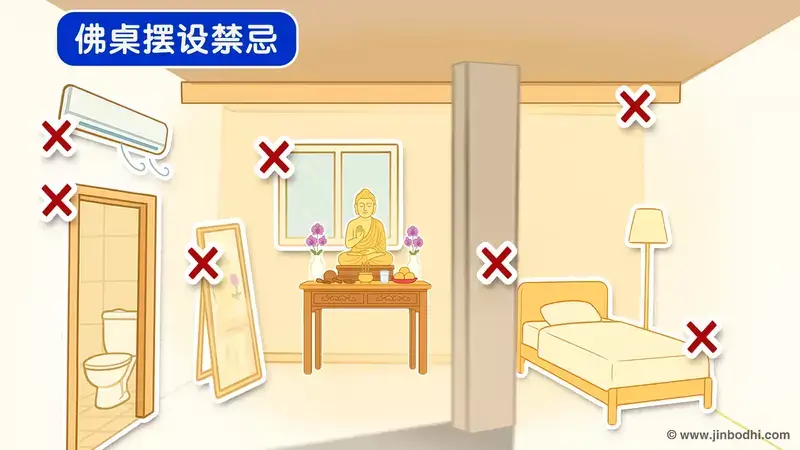
Once you understand the basics of setting up a Buddhist altar, you may also wonder about specific placement taboos. Below is a list of common precautions to help you avoid mistakes:
- The altar should not be near damp or high-heat areas, such as bathrooms or kitchens, to show respect to the Buddhas and Bodhisattvas.
- Since the bedroom is a private space, placing an altar there is generally not recommended unless absolutely necessary.
- The wall behind the altar should be solid and stable. Avoid placing the altar in front of windows, movable doors, or glass walls to ensure a secure and
- respectful seat for the deity.
- Avoid placing the altar under exposed beams, as this may exert symbolic pressure on the deity.
- Avoid air conditioner vents above the altar, as cold air blowing directly may be seen as disrespectful.
- Avoid placing the altar directly in front of columns or pillars with sharp corners, as this creates a harmful energy known as “piercing sha” (角刀煞), disrupting the altar’s harmony.
- Avoid placing mirrors in front of the altar, as reflections of sacred images are considered disrespectful.
How Should a Buddhist Altar Be Arranged? Statues, Offerings, and Layout Tips
A home altar area should be clean, simple, and dignified. Below are some helpful arrangement suggestions:
- Place the main statue in the center of the altar. It’s best to honor one deity to avoid visual or energetic clutter.
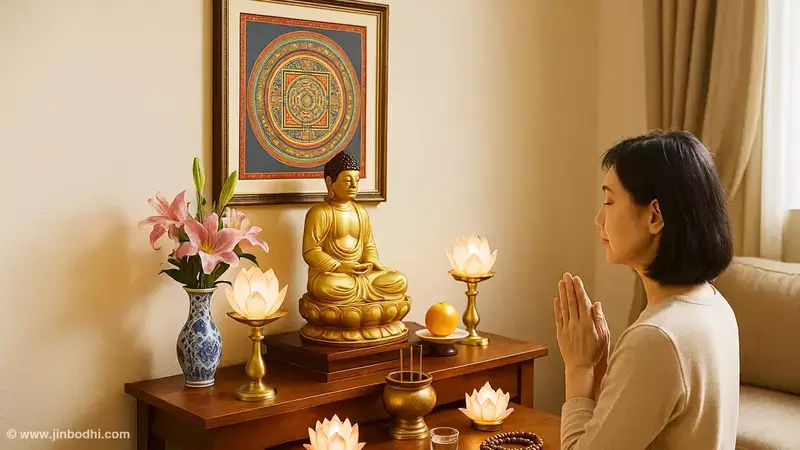
- Items on the altar should be symmetrical—such as flower vases, candle holders, and light stands. Place the incense burner in the center, and use either 1 or 3 water offering cups.
- Prepare ritual tools like a wooden fish (traditional drum), singing bowls, handbell, or prayer beads for daily worship use.
- Buddhist sutras may be placed in front of the altar or stored in a sutra cabinet, and taken out when chanting.
- Choose appropriate couplets or wall hangings to decorate the altar.
- The statue’s material can vary—paper, wood, or bronze are all acceptable—but make sure the size and style are appropriate.
- While not strictly required, a common placement principle is “deities on the right, ancestors on the left”.
- There’s no strict rule for the number of offerings. You may prepare fresh flowers, fruit, or purified water, but avoid withered or spoiled offerings.
All of the above recommendations can be flexibly adjusted based on your situation. Modern living spaces are often small, and it may be difficult to find the “perfect” spot for a formal altar. Therefore, what matters most is your sincerity. As long as you practice with devotion and reverence, even a corner of your desk can become a sacred place. There’s no need for incense burners, candles, vases, water offerings, or flowers—the true connection with the Bodhisattvas lies in a pure heart, and that’s where your spiritual journey begins.
Bodhi Meditation | Sharing Feng Shui Wisdom to Help You Live Smoothly
Beyond setting up a home altar, many people turn to Feng Shui wisdom to improve their lives. The Bodhi Meditation YouTube channel shares valuable knowledge on Feng Shui, face reading, and fortune—guiding you to follow Grandmaster JinBodhi’s teachings on transforming destiny and receiving the blessings of good Feng Shui.
For those unable to set up a Buddhist altar at home, Bodhi Meditation Centers worldwide offer spaces for meditation and chanting, and provide oracle readings and life guidance services to help one eliminate worries and restore inner peace.
Further Reading:
Explore Life and Destiny: Is Your Fate Predetermined? Can It Be Changed?
Can Chanting the Buddha’s Name Improve Your Feng Shui and Energy Field?